Your dog comes every time in the kitchen. Then a squirrel runs across the yard, and suddenly your dog has never heard its own name. The treat in your hand might as well be a pebble. Every owner hits this wall sooner or later. It does not mean your dog is stubborn or that training failed. It means you just met a competing reinforcer.
What is a competing reinforcer?
A reinforcer is anything that makes a behaviour more likely to happen again. Food is one. So is a game of tug. If you have read our article on the four quadrants of dog training, this is the "R" in +R.
A competing reinforcer is simply a different reward pulling the dog the other way. You are offering a piece of cheese for coming back. The squirrel is offering a chase. The deer trail is offering the best smell in the county. The dog across the street is offering a friend. Your dog weighs them up in a split second and goes with whatever is worth more to it right then.
Dogs do not do what we ask out of duty. They do what pays. That is not a flaw. It is how every animal learns, people included.
Why food and toys lose to a squirrel
There are a few reasons the squirrel tends to win.
- Chasing is built in. Running after something that moves is wired deep into most dogs. Nobody had to teach it, and it feels great.
- The world pays on its own. Every time your dog gets to chase, sniff or greet without your say, it gets paid by the environment, not by you. That is called self-reinforcing behaviour, and it gets stronger every time it happens.
- We are boring. If the only time the treat comes out is in the kitchen, and the only game is a lazy toss, we cannot compete with a live animal.
- The behaviour is not ready. A recall that has only been practised in a quiet room is not yet a recall. It is a kitchen trick. The dog has never learned that the word still counts when something exciting is nearby.
- We are too close. Distance matters a lot. A dog that can ignore a squirrel at 50 metres may not be able to at 5.
Prevention: win the contest before it starts
Most of the work here happens long before the squirrel shows up. Our method is always the same: lure, mark, word, reps, proof. Distractions belong in the last step, proof, and only once the first four are solid.
1. Make yourself worth paying attention to
The best defence against a squirrel is a dog that thinks you are the most interesting thing outside. That comes from play. Tug, chase games and real interaction, where the dog wins often and you are part of the fun. A toy lying on the floor is just an object. A toy in your hand, moving and alive, is a game that only you can give.
This matters even more for dogs that do not care much about food. Plenty of our mastiffs and Corsos will walk past a treat but light up for a good game of tug. Find what your dog really loves and build that up.
2. Keep the good stuff special
If the favourite toy lives on the living room floor all day, it is worth nothing at training time. Put it away and bring it out only for training. Use your best food for your hardest work. Save the cheap stuff for easy reps at home.
3. Control the environment
Every time your dog gets to chase the squirrel on its own, the squirrel gets more valuable and you get less. So while you are training, do not give the dog the chance to practise ignoring you. A leash or long line, a fenced area and good timing are your friends. Do not call your dog if you cannot follow through. Use a word you know will work, or go and get the dog.
4. Use distance and build up slowly
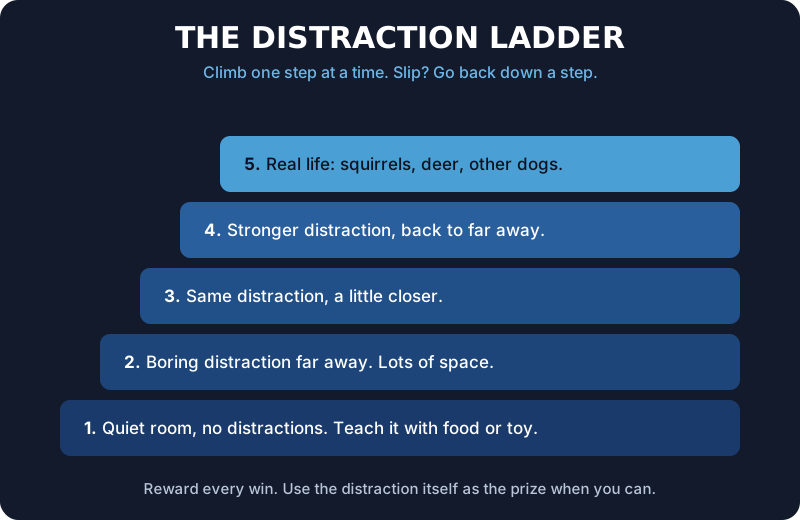
Think of distractions as a ladder. Start with something mild, far away. When your dog is winning every time, move a little closer, or make the distraction a little more exciting. Change one thing at a time. If your dog fails, that is your sign to step back down, not to push harder.
5. Let the distraction become the reward
This is one of the most useful ideas in all of dog training, and it has a name: the Premack principle. In plain English, it means a dog will do something it wants less in order to get something it wants more. Parents use it all the time: eat your vegetables, then you get dessert.
With a dog, that means the thing it wants becomes the payoff for doing what you asked. Your dog wants to sniff that post? Ask for a sit, then say "okay" and let it go sniff. Your dog wants to greet a friendly dog? Ask for a calm heel first, then release it to say hello. On a long line, call your dog away from a great smell, say "yes" the moment it turns toward you, back up so it comes in fast and straight, reward the arrival, then send it right back to the smell with "okay".
Done this way, the distraction stops being your enemy. It becomes your biggest reward, and you are the one handing it out. Your dog learns that listening to you is the fastest way to get what it wants. Some things, like chasing deer or cars, can never be used as a reward, but sniffing, greeting and exploring often can.
When it happens anyway
Even with great prevention, there will come a day when the squirrel wins. Real life does not follow a training plan. This is the point where many owners get stuck, and where we lean on fair punishment.
That word scares people, so let us be clear about what it means. In training, punishment just means "less of that". It does not mean anger, and it does not mean hurting the dog. And there are rules.
Only for a behaviour the dog truly knows
A correction is only fair if the dog knows exactly what it was asked to do. That means the behaviour has been taught, practised many times and proofed around smaller distractions first. If the dog has never succeeded near that kind of distraction, it is not disobeying. It simply cannot do it yet. We never punish confusion. A confused dog needs more teaching, not a correction.
"No" first
We always give the "no" marker before a correction. It tells the dog "that choice was wrong" and gives it a moment to fix it on its own. Over time, many dogs start to fix it at "no" and the correction is hardly ever needed.
Match the correction to the distraction
A leaf blowing by and a deer bolting across a field are not the same. The correction should be just strong enough to break through what the dog is facing, and no stronger. With a leash, that may be leash pressure that releases the moment the dog turns back to you, which is negative reinforcement, or a quick pop for a dog that knows the rule well. With the e-collar, we find each dog's lowest working level and correction level, and adjust up or down to match how strong the distraction is. A level that works in the backyard may not register next to a deer, and a level that works next to a deer is far too much in the kitchen. We never use e-collar corrections on puppies.
One more thing to expect: a dog that has been paid for chasing for a long time may try harder before it quits. Expect a short rough patch and keep your setup safe.
Then help the dog win, and reward it
The correction is not the end of the lesson. The moment the dog turns back toward you, mark it with "yes" and pay it well: food, toy, praise, or the release to go sniff. Then set up an easier rep so the dog gets a clean success. The dog should come away knowing two things: ignoring you does not work, and coming back pays.
If you find you are correcting the same thing over and over, stop. That is a sign the dog does not understand, or the distraction is too close or too strong for where the dog is. Go back down the ladder.
Why using all four quadrants is fair
Some people believe you should only ever use rewards. The trouble is that a reward can only win if it is worth more than what the world is offering. Sometimes nothing in your pocket will ever beat a deer. A dog that has only ever heard "yes" has no way to learn that ignoring you is not an option.
Others reach for corrections first. That is not fair either. A dog that gets corrected before it understands is just confused and worried.
We use all four. Positive reinforcement builds the behaviour and the love of working with you. Negative punishment, like the game stopping or the sniff being taken away, shows the dog that ignoring you costs it what it wants. Negative reinforcement teaches the dog how to turn off leash pressure or the e-collar's working level, so it always knows how to win. And positive punishment, used only on behaviours the dog truly knows, after "no", gives the clear message that sometimes the squirrel is simply off the table.
Each one tells the dog something different. Together they give it the full picture, and a dog with the full picture is calm, confident and safe off leash. That is the fairest thing we can give it.
Where to go from here
To go deeper on using what your dog wants as the reward, read The Premack Principle: Using What Your Dog Wants as the Reward.
If you are new to the e-collar, start with our free guide, E-Collar Introduction (free when you join our mailing list). It walks through charging your marker and pairing the low level with good things before any correction is ever used.
To work through distractions with us in person, have a look at our training courses, from Puppy Foundations to Basic Obedience and beyond. We offer free walk-in consultations, so come by and meet us with your dog.